
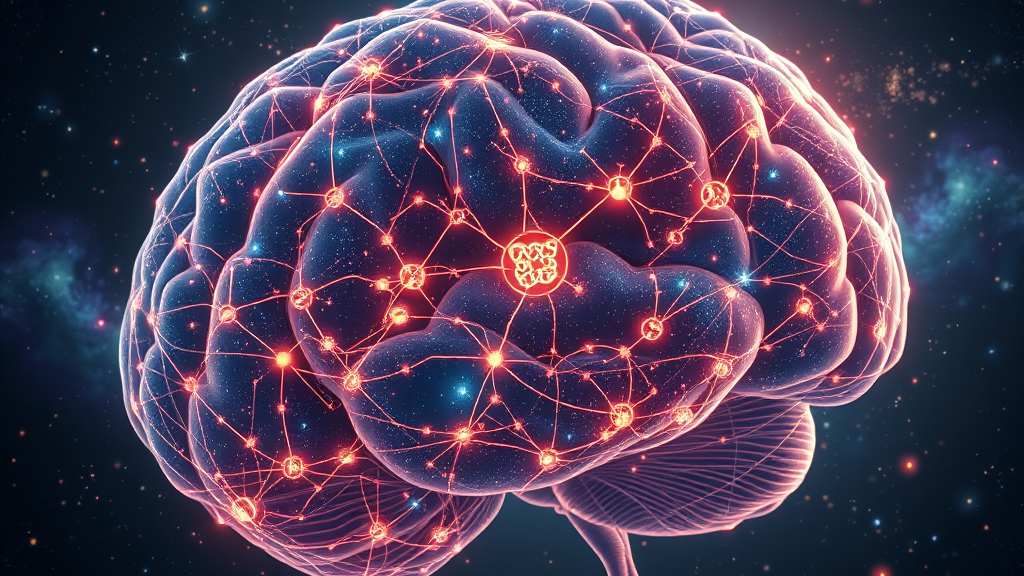
Sometimes I wonder if the universe designed the brain in its own image.
Billions of neurons fire in quiet synchrony. They form constellations of thought and emotion. It feels less like biology and more like astronomy turned inward. When we look at the night sky, we trace galaxies spiraling into infinity. We’re really looking at a reflection of ourselves.
Neuroscience and cosmology are, in a sense, two sides of the same mystery. One seeks to understand the vastness outside of us; the other, the vastness within. The brain, with its electric storms and delicate architectures, holds universes of memory, emotion, and imagination. A single thought is like a star — flickering, burning for a moment in the dark. Some thoughts expand into galaxies of meaning; others collapse, unseen, into silence.
And then there are the black holes — the places where our thoughts vanish. Those moments of forgetting, of grief, of mental noise so heavy it swallows everything around it. Neuroscientists call it inhibition, suppression, or decay. Poets might call it the gravity of the soul. Just as light disappears into a black hole, some emotions fall inward. They are too deep to be seen. Yet, they shape everything in their orbit.
But even in that darkness, not all is lost. Astrophysicists tell us that black holes leak light in whispers — through radiation, through time. And perhaps our minds do too. The thoughts we thought were gone forever return. The dreams we buried sometimes emerge again. They come back refracted and transformed, like hawking radiation escaping from the edge of black holes.
To study the brain is to study the stars. Both remind us that chaos can be beautiful. They show that order can emerge from uncertainty – a property called emergence. Everything we know is made of the same stardust. Each neuron, each atom, carries a memory of creation.
The cosmos is not out there. It’s within us — folded into our neural galaxies, pulsing with the same quiet rhythm as the stars. We are the universe observing itself, thinking, remembering, dreaming.
And perhaps that’s the grandest symmetry of all:
The mind has a tangled beauty. It is not striving to grasp the cosmos. It is the cosmos, learning to understand itself.
 The Conscious Canvas